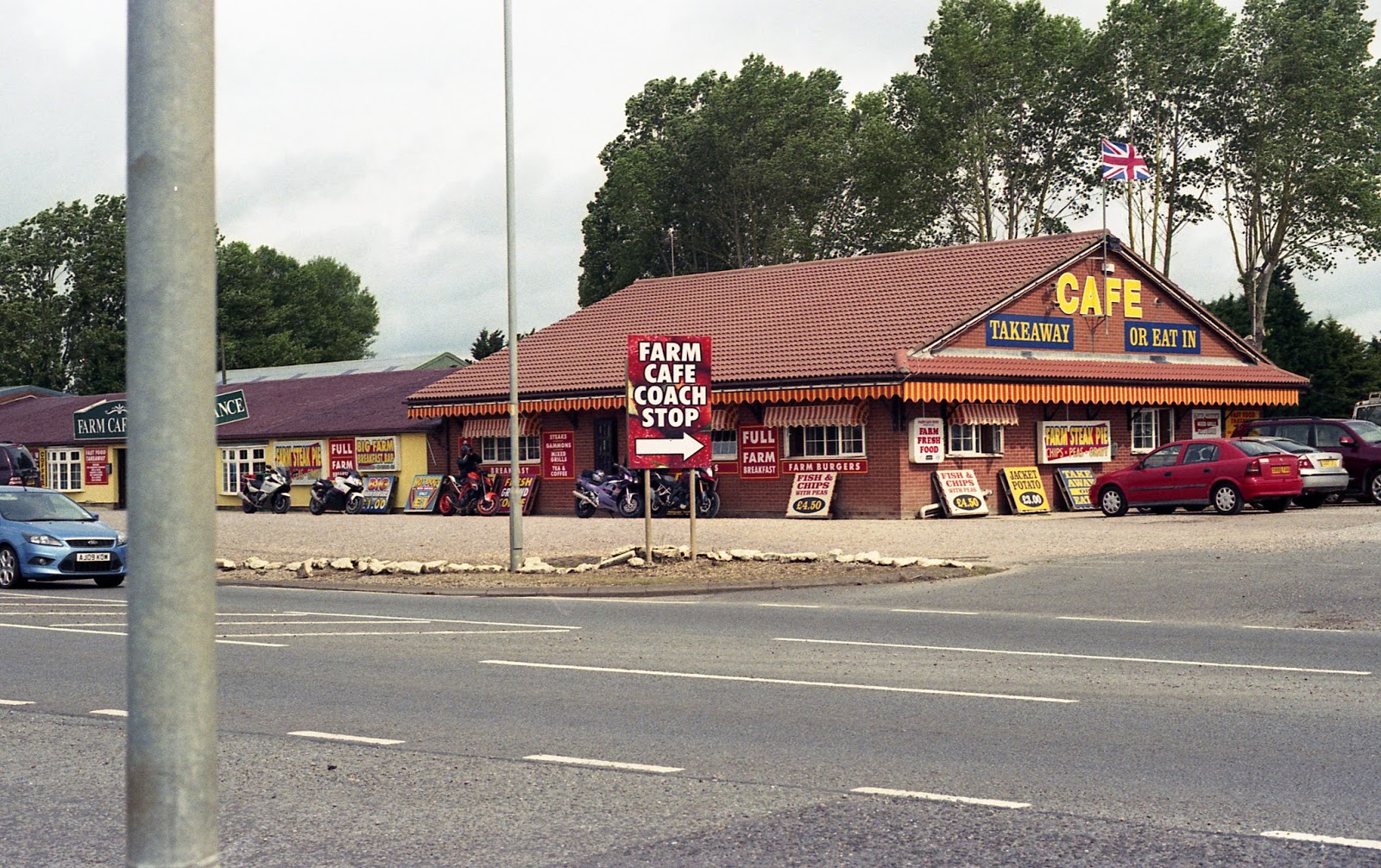
Lincolnshire and the Fens are one of the last remaining centres for the traditional road house, the transport cafes that give respite from miles of flat road and apparently featureless countryside. They've changed since the coach stops of my childhood, Nissen huts and plywood creations with an obligatory jukebox and solitary pinball machine, but the homespun spirit remains.
The area was a fighter and bomber frontline in WW2 and the Cold War. A Hawker Hunter sits in the car park by way of a reminder.
The signage has more in common with the United States than Eastern England.
Motel, coach stop, museum, collectables.
The empty quarter
Type face heaven (or hell)
Miniature windmill, tractors, hand painted cast off something. I once saw a German bomber gun port pressed into service as a greenhouse nearby.
It's possible to plot the expansion of this wayside café from the architecture.
Showing posts with label psychogeography. Show all posts
Sunday, 17 July 2016
Fenland Road Houses
Labels:
fenland,
psychogeography,
road house,
signage,
strange,
transport café
Thursday, 2 June 2016
All the same, all different, part one
The rivers of the south Pennine divide share similar characteristics, they begin in high, rain soaked moorland, places as remote as anywhere in England, before quickly taking on an industrial aspect in the valleys. The River Holme is no exception. These spate rivers have been controlled since the earliest days of the industrial revolution, first as a source of power, then as a supply of drinking water to reservoirs for the burgeoning towns and cities of the north. This is a walk where the upland river meets human occupation.
For sale, one mill
Overgrown path, Hinchliffe Mill
House backs by river, Hincliffe Mill
Snicket steps, or is it a ginnel?
The river bank is full of sluices and culverts from former industrial uses
Last time I walked this way the mill was still in use. All's quiet now
This mill seems to have been extended and modernised in boom times. It's put to artisan use now
The river holds a small and fragile brown trout population, which will become even smaller and more fragile with such fishing tactics
Bridge to cricket club, locked
Art Deco mill by River Holme, sold
Prime building land
Camp site and caravan park, Thongsbridge
New industrial unit
Brownfield meets greenfield. Most of it is houses in waiting.
Demand
As the river has never been navigable, my guess is this was a lavatory
Millstone grit outcrop at Brockholes, with mill backing on to river
For sale, one mill
Overgrown path, Hinchliffe Mill
House backs by river, Hincliffe Mill
Snicket steps, or is it a ginnel?
The river bank is full of sluices and culverts from former industrial uses
Last time I walked this way the mill was still in use. All's quiet now
This mill seems to have been extended and modernised in boom times. It's put to artisan use now
The river holds a small and fragile brown trout population, which will become even smaller and more fragile with such fishing tactics
Bridge to cricket club, locked
Art Deco mill by River Holme, sold
Prime building land

Camp site and caravan park, Thongsbridge
New industrial unit
Brownfield meets greenfield. Most of it is houses in waiting.
Demand
As the river has never been navigable, my guess is this was a lavatory
Millstone grit outcrop at Brockholes, with mill backing on to river
Subscribe to:
Posts (Atom)


